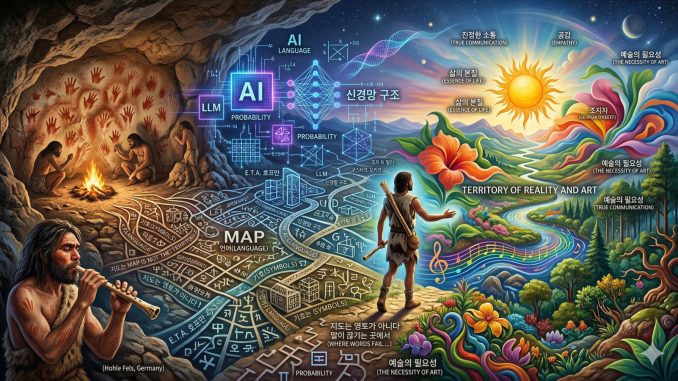
Tens of thousands of years ago, somewhere beyond a tropical jungle, a group of Homo sapiens, the first of our kind, gathered inside a cave. Armed with a burning branch to push back the dark, they crowded before one wall and began to do something remarkable. One of them put their hand against the cold rock, packed red ochre around it, and slowly, deliberately, pressed a handprint into the stone.
Why on earth did these Homo Sapiens try to leave their traces on the cold cave walls? Not even drawings of the animals they wanted to hunt, but handprints.
A hand image discovered in Sulawesi, Indonesia, dated to roughly 67,000 years ago offers a interesting clue. What the researchers noted was that this image differed from magical rituals or expressions of collective emotion, such as drawing prey intended for hunting. Our distant ancestors were attempting to communicate with others through these primitive forms of artistic activity.
Then, sometime later, on another continent, a strange sound began threading through a European forest. The sound as if resembles leaves rustling in the wind or someone sobbing was produced by a small, hand-sized flute carved from a vulture’s wing bone, which archaeologists excavated from the Hohle Fels cave in Germany. Rather than mere noise, this sound, created by intentionally adjusting the pitch, is evidence that our human ancestors knew how to produce the music they desired.
A red handprint on the cave wall and the sound of flute made of bone must have been humanity’s very first language. A way of sharing one’s life, imbued with real-life experiences, through images and sounds rather than symbols or characters like modern language. That is precisely the beginning of the mysterious genre we now call ‘art’.
What Did We Forget?
As time passed, humanity began to gradually let go of this rich mode of communication. Instead, we invented a convenient and efficient tool called ‘language.’ Of course, language is an amazing invention. Most of the civilization humanity has built owes a debt to it. Thanks to language, we have been able to rapidly convey complex thoughts, accumulate knowledge, and create civilization.
However, can language truly carry everything?
The German Romantic writer E.T.A. Hoffmann once wrote: “Where words fail, music begins”. Composer Gustav Mahler made a similar confession in an 1896 letter: ‘If I could sum up my experience in words, I would never have made it into music.’
The reason one of history’s greatest composers spent his life writing music was precisely that language could not do what music could.
Georgia O’Keeffe, the American painter, said it plainly: ‘I found I could say things with color and shapes that I couldn’t say any other way — things I had no words for.’
Mahler, O’Keeffe, Hoffmann, they all point to the same truth. Art exists in the space where language can’t touch. They understood that the moment we settle for words alone, the luminous forms of connection we were born with begin to dim.
Can One Word Hold the Same World for All of Us?
The linguist Alfred Korzybski said once, “The map is not the territory.”
What exactly does this short sentence mean? Just as we consult maps that represent actual spaces with symbols to obtain information about them, we use language to understand the world. However, just as a map cannot accurately capture the shape or atmosphere of the land, language also fails to fully capture the rich textures of reality. In other words, Alfred Korczyvski has embodied the semiotic concepts of language in a map, and the complex and diverse reality of space in a territory.
For example, when we say a “apple,” a round, red fruit comes to everyone’s mind. But only with the word, we cannot perceive the sensation of holding it in our hands, the burst of tangy juice when taking a bite, or the scent of apples spreading through an orchard under the autumn sunlight. That is because such things can never be contained from the word, “apple.” We simply place a concept, substituted into the linguistic symbol of “apple,” into our minds and transfer it to one another.
In this way, aren’t we living within a frame created by language, which is neither reality nor imagination? Many things we actually experience and feel cannot be contained within language. While the efficiency of communication has increased in terms of form, the essence of being a social human being—one who sought to empathize with one another and communicate more deeply—has gradually scattered like fog as a result.
The fact that art and literature are losing their place in educational settings around the world is perhaps not unrelated to this trend. In an era where even education is driven by profit, art and literature are bound to be pushed to the end. However, if art is what early humans have developed to understand and empathize with one another, what are we losing now? The political and social polarization that engulfs the world today may also be the price we are paying for losing art and literature, the ultimate means of communication that once enabled us to understand and empathize with one another.
The Language, made by AI.
What is interesting is that, even at this very moment, another change is taking place in the structure and form of language. LLM—that is, AI, a massive language model—is at the very center of this change.
After learning trillions of texts, AI identifies the relationships and distances between words, recalculates them, and presents results that combine the most natural-sounding words. Having become capable of understanding complex contexts through the cutting-edge technology of neural network architecture, AI is now churning out countless sentences in the form of news articles, books, and social media posts. These results are then distributed and used again as data for AI training. To borrow the words of linguist Saussure, the way in which the words (paroles) created by individuals gathered to form the rules (langue) of language is now being redefined by the words (paroles) created by machines that calculate sentences through probability, effectively redefining the rules (langue) of human society.
This recalls a single question. With what now should we convey the music that “begins where words cease”that is, the emotions and experiences that language could never possibly capture? Can the language of AI, armed with probability, truly fill that void?
If we ourselves choose to lay down the language of creative communication known as art and settle within the framework of a machine-generated language of reproduction, what will happen to humanity? Perhaps we may never again reach that realm of experience beyond language, which Mahler so desperately tried to capture in his music.
Back to the Cave Wall
Once again, I imagine the red handprints on the cave walls and the sound of flutes made of eagle bones. To whom did those Stone Age ancestors, who left red handprints on the cave walls, and those human ancestors who hollowed out eagle bones to blow faint sounds, wish to say what?
Could it be that we have begun to drift away from both reality and imagination because we have bound our own thoughts within the structure of this sophisticated language that we ourselves created? As we think and converse only within the boundaries set by language, communication seems to be pushed further into an increasingly impossible realm, isn’t it?
Now, it seems we need to break free from these narrow frames of thought, like maps that have briefly reduced reality, and once again move toward the space of truth that exists beyond the frames.
If you feel something that cannot be expressed in words, and if the impulse to share those emotions, then true human nature will still exist inside you.