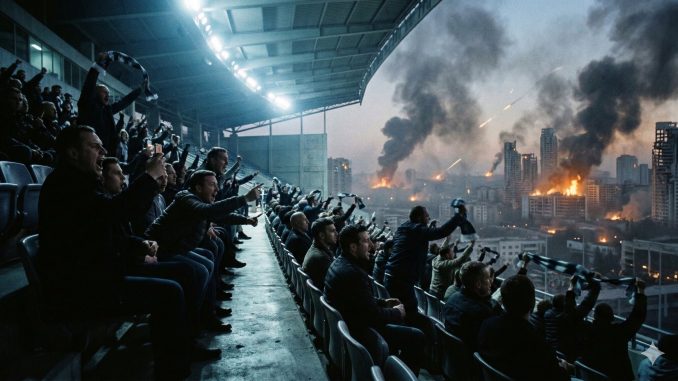
The news that the long-feared U.S. military strike on Iran has brought a strange sense of déjà vu for those of us who have lived through more than a quarter of the twenty-first century. Technology advances relentlessly, the world grows ever more connected but the reality unfolding before us keeps contradicting everything we believe about human progress. Watching an America that pursues unfulfilled greed, a Middle East that never stops bleeding, a Russia that finds its current territory insufficient, a China that dreams of global supremacy, it becomes difficult to escape the thought that the planet we inhabit is still, at its core, one vast battlefield.
And yet, standing before these tragedies scattered across the world, the truth we must confront may not be how the front lines were drawn. It may be the perspectives we bring to them.
Why are we so captivated by the conflicts of others? Are we not, perhaps, calling for peace with one breath while quietly watching someone else’s defeat and humiliation with a kind of hidden fascination? It is time to see us in the mirror and face the voyeuristic impulse we have kept concealed.
What We Have Chosen to Believe
Humanity has long told itself that we have been working, generation by generation, to reduce war. To escape the cycles of violence carried out in the name of religion and ethnicity, to move beyond the bloodshed of revolutions that tore down old orders only to install new ones, we built international institutions, signed treaties, and forged a shared language of human rights. We believed that these efforts were making the world, slowly but surely, better.
What the current international order reveals, however, is how fragile the foundations of that belief have always been. Great powers have reshaped borders by force, for their own interests, and in the flow of those actions, contests for dominance have not ceased.
Within the physical limits of this planet, the duel of desires may be an unavoidable reality. Even so, we owe ourselves an honest question: has the belief in human progress such as peace, freedom, and humanitarianism been, at least in part, an illusion?
The historian Thucydides wrote these words 2,500 years ago, in his <Peloponnesian War>, “The strong do what they can, and the weak suffer what they must.” It might be a cold but an accurate aspect of reality.
Refusing to look away from that possibility is the first step toward understanding the present properly.
Why Our Outrage Runs at Different Temperatures
The crowds who watched gladiators fight to the death in the Colosseum made their judgments on the emotion. They yelled at opposite gladiators to follow the rules but didn’t care about dirty play by their favorite ones. Could it be that our perspective on the current conflict is based on such “selective justice”?
When Russia invaded Ukraine in 2022, the world responded quickly. Social media was filled with Ukrainian flags. Fundraising campaigns broke records. Governments moved with unusual speed to provide support. The words “international law,” “sovereignty,” and “freedom” filled online spaces.
And now, faced with the U.S. invasion of Iran? Many of the same voices are saying something different. “We need to think about this strategically.” “It may have been unavoidable for regional stability.” “Iran provoked this.” Although the nature of the act, an invasion, is the same, the public’s reaction differs depending on which country is the offender.
The opposite situation is the same, too. Those who condemn the U.S. attack on Iran as imperialism often fall silent, or reach for “historical context,” when it comes to military aggression by Russia or China.
This isn’t just a matter of hypocrisy. This suggests that there is a structural problem with the way we view the suffering of others. When we see a bombed city, we do not first register the people buried under the rubble. We registered the name of the country the city belongs to. And then, based on whether that country is on our side, we decide to turn our outrage on or off.
Are we sincerely emphasizing to others pain? Or are we using that pain as a tool to confirm what we already believe politically?
The question pushes us into uncomfortable territory. The terror an Iranian child will face is not, in any essential way, different from the terror a Ukrainian child has faced. The fear of an explosion overhead, the grief of losing family, the sensation of a life dismantled overnight do not change in weight depending on the country where they occur. And yet we weigh them with different measures.
American philosopher Martha Nussbaum emphasizes that we are all inherently “fragile beings.” This recognition of shared vulnerability, she suggests, is the starting point for any genuine moral imagination. When we acknowledge that the peace we feel today exists simply because we were fortunate enough to be born somewhere safe, we take the first step toward feeling another person’s suffering as if it were our own.
When War Becomes Content
War, today, reaches us differently. High-definition footage of missiles striking their targets flows through the feeds between travel and food photos. Drone footage of ruined cities is shared in real time. Analysis of military operations is shown like sports commentary.
We watch the explosions on the screen and feel a combination of fear and excitement and then, almost without noticing, we become spectators. Grounded in the relief that we are not there, we assess, predict, and comment as though watching a sports match. During this, the horror of war is diluted, and what remains is the logic of winning and losing, and the pull of a compelling story.
One of the reasons we cannot stop watching, even as we insist, we want peace, is that these conflicts offer an easy way to feel politically superior. Defining someone else as evil and positioning ourselves on the opposite side is simple and satisfying but it distorts reality dramatically, and without our realizing it, draws us into a kind of dogmatism.
And that simplification has a cost. The more the crowd roars, the more the players on the field reach for increasingly extreme methods. This is something we are too quick to forget.
We Are All Fragile
We can all be hurt at any moment. We can all lose the people we love. Everything we have built can come apart overnight. This is a condition that all humans have, regardless of nationality or ideology.
Fundamentally, the child crying on a battlefield, the elderly person who has lost their home, even the soldiers standing at the front line with a rifle are as vulnerable as we are. When we admit that the ordinary peace of our daily lives exists simply because we were lucky enough to be born in a safe place, we become capable of moving a little closer to the pain of those who were not.
This may sound like sentiment but it is a matter of clear fact. And refusing to look away from it is the minimum defense against being swept along by the language that justifies violence.
Beyond the Logic of Power
The planet is a closed system. Resources are finite, territory is fixed. Within those limits, the collision of competing interests in the name of nations and peoples is a reality that cannot be entirely avoided. Great powers contesting zones of influence is a pattern that has repeated throughout human history.
History reminds us that it’s difficult to be a true victor in war, and that conflicts that end in violence always contain the seeds of new conflicts. The mishandling of the First World War led to the Second World War, and the end of the Cold War in the late 20th century immediately ushered in an era of new regional conflicts, are testaments to this.
Facing these lessons, the question we need to ask is not “how do we win?” but “how do we survive together?” This is not defeatism. It is the more realistic stance — the one that takes a longer view.
And one more thing. In this vast chess game where the US strikes Iran, Russia expands its territory into neighboring countries, and great powers compete for hegemony, what is ultimately sacrificed is not the abstract concept of a “nation.” It is the people who live inside those states. Violence carried out in the name of a nation, ethnicity, or religion is, whatever justification it is given, an act that crushes individual human dignity. Keeping that truth present is the starting point for refusing to be carried uncritically along by the narratives of political leaders.
Leaving the Stands
Whether the game is over or not, the spectators could go home. Whatever happens at the stadium, life beyond the stadium goes on.
Living far from conflict zones, and the fact that our daily lives are filled not with bombing but with commuting, meals, and simple pleasures. This isn’t a result of our own choice, but rather a luck. If we fail to recognize this luck, we won’t even realize how meaningless our comments about the scars of war endured by others are.
If you were born in a country you’re criticizing, could you still criticize the country with your current perspective? If air raid sirens were sounding over your city today, would you still speak of this war in the same language you use today? This is uncomfortable to imagine. But it is precisely that discomfort we need to live with, if we want to engage honestly with the pains of others.
Leaving the frenzied stands won’t immediately stop the war. But at the very least, it will allow us to recognize that the information we consume, the language we use, and the opinions we shape are all connected to either exacerbating or, at least to a lesser extent, mitigating the violence of this era.
When empathy is mentioned, the argument such as “Emotions prevent seeing reality” comes out quickly. Their argument is that international politics is a field that requires logical consideration of interests, and that letting emotions take precedence only blurs reason.
But empathy is not sentimentalism. It is the capacity to examine the premises of our own judgments. To think, one more time, about what the policies we believe in mean to those who are not their beneficiaries. To ask how the choices we support are experienced by the people who must live inside their consequences. This is not an excess of feeling. It is closer to a precondition for responsible judgment.
Think about the comments posted under this morning’s conflict news. How many of them were written by someone who had genuinely tried to imagine the pain of the people caught inside it? Maybe our comments are creating another front.
The Way Forward
The age of conflict is not made of battlefield fire, only. Divided public opinion, selective outrage, manipulated emotion, and insensitivity to the suffering of others, all these are quietly destroying the world we live in together.
In every piece of news we encounter, every comment we post, every word we choose in conversation, the conflict can deepen or diminish. Which direction it moves depends on the questions we bring to how we see the world.
The international situation we face demands a high degree of what might be called moral imagination. That is not simply a call to become pacifists. When we lose the ability to see the world through eyes other than our own, we are always at risk of falling from the stands down onto the arena floor.
How accidental is our sense of justice? How much of our anger has been manufactured for us? And when will we finally set down the habit of watching other people’s tragedies from a safe distance, and find our way into the solidarity of shared pain?
Searching for answers to these questions is the first step, toward ending the barbarism that continues into the twenty-first century, and toward what human progress might mean.