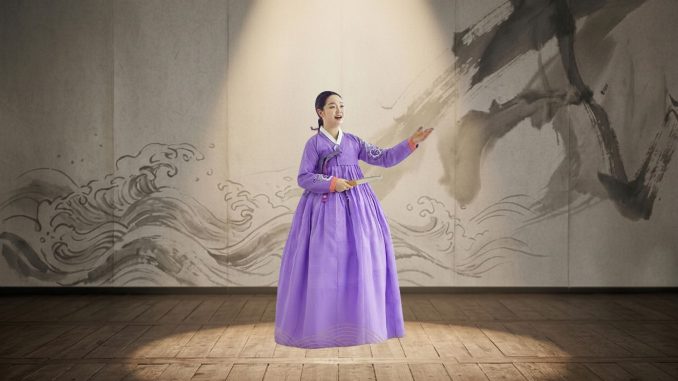
On February 21st, I visited the Pungryu Sarangbang of the National Gugak Center in Seocho-dong, where I experienced a joyful artistic scene where the passionate breathing of a young singer and the smooth drum rhythm of a master drummer intersected.
Jultak-dongsi — The birth of a to-be master.
[Note: The concept of “Jul-tak-dong-si” (啐啄同時) originates from the ancient philosophy of depicting the moment when a chick hatches. It signifies the simultaneous encounter of two forces, the chick pecking from the inside and the mother hen pecking from the outside, breaking the shell. In Korean artistic tradition, it’s also used to express the bond between teacher and student.]
The performance was subtitled Jultak-dongsi — a single phrase carrying the weight of the evening. With that word, Kim Hye-yul, the young singer at the center of this recital, announced her intention to be born anew as an artist on her own terms.
Kim is due to graduate from the Korean Traditional Music department at Seoul National University in February 2026; on the evening of the performance, she was still a university student. This was her very first ‘wanchang’ — a complete, uninterrupted performance of a full pansori work from beginning to end.
[Note: Pansori is a genre of traditional Korean musical storytelling in which a single vocalist (sorikkun) performs an entire dramatic narrative accompanied only by a drummer (gosu) who plays the buk, a double-headed barrel drum. A complete pansori work can last anywhere from three to eight hours. The wanchang, literally ‘full singing,’ is considered a defining rite of passage: mastering the vocal, physical, and mnemonic demands of an entire work without interruption.]
Her voice is not yet fully formed — in the world of pansori, if the body would be the instrument, the instrument is not considered complete until the singer is at least in their thirties. Slower passages and low-register phrases revealed the strain of an instrument still developing, and there were moments where the thread of the lyrics slipped. Yet the sheer act of a singer in her early twenties holding the stage alone for five hours was something to witness.
Kim Nayoung, Kim Hye-yul’s teacher and the evening’s moderator, who is a certified holder of National Intangible Cultural Heritage No. 5 (Pansori: Simcheonggga), explained that preparing a wanchang is an unrelenting struggle with oneself. It is not enough to memorize the lyrics in the mind. Every muscle in the body must absorb the pitch and rhythm until the next phrase rises not from memory but from the body itself, unbidden. Legend has it that singers of old would stand beneath waterfalls until their voices were perfectly made, then sit facing a wall and sing the entire work repeatedly until nothing remained but the singing. That this young woman had undergone some version of that journey was quietly present in every moment of the evening.
Beompi-jungnu — Why Is This Music Slow and Proud?
[Note: Beompi-jungnu (泛彼中流) translates roughly as ‘Drifting upon the mid-current.’ It is the most celebrated passage in Simcheonggga and describes the moment Sim Cheong’s boat moves out onto the open sea toward her death.]
The most celebrated passage in Simcheonggga is Beompi-jungnu. It is composed in jinyangjo — the slowest of pansori’s rhythmic cycles — in which a single beat unit spans 24 pulses, stretching time far beyond the pace of ordinary breath.
[Note: Pansori uses a system of rhythmic cycles called jangdan. Jinyangjo (진양조) is the slowest, with 24 beats per cycle; at the other end sits hwimori, a galloping cycle used for climaxes and chases. The modal palette is equally expressive: gyemyeonjo (계면조) is the plaintive, minor-inflected mode associated with grief and longing, while ujo (우조) is the clear, elevated mode associated with grandeur, dignity, and transcendence.]
What is striking is that Beompi-jungnu is not composed in gyemyeonjo — the mournful, minor-inflected mode one might expect for a scene of a fifteen-year-old girl sailing toward her death. It is composed in ujo: clear, expansive, and majestic.
(Listeners unfamiliar with pansori are encouraged to search for footage of the late master singer Seong Chang-sun, designated holder of National Intangible Cultural Heritage No. 5 in 1991, performing this passage. The slow grandeur of the music speaks for itself.)
Wagner’s Women, and Sim Cheong
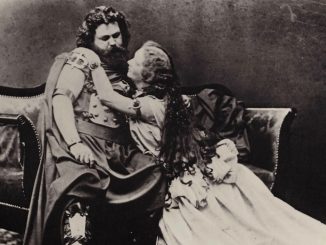
Listening to Beompi-jungnu, the mind moves, perhaps unexpectedly, toward Wagner. Senta in The Flying Dutchman. Elisabeth in Tannhäuser. Brünnhilde in the Ring Cycle. Wagner returned again and again to what critics including Catherine Clément and Theodor Adorno have identified as the logic of ‘redemption through woman’: the idea that the existential failings of the male hero can only be resolved through the total sacrifice of a female figure. In this reading, Wagner’s heroines are sacrificed on the altar of patriarchal contradiction, aestheticized and disposed of under the name of art. Wagner, these critics suggest, inadvertently confessed that incomplete masculinity cannot redeem itself — it requires the absolute Other, the woman, to do it.
Is Sim Cheong the same kind of figure? Is the narrative of Simcheonggga ultimately a mechanism by which a society built on filial piety and male authority stabilizes itself through the sacrifice of a fifteen-year-old girl — pure, obedient, disposable?
However, the musical structure of “Simcheonggga” that came to mind on the way back from the performance quietly reversed this thought. If the slow, stately “Beompijungryu” holds musical structural validity, perhaps we can interpret “Simcheonggga” from a different perspective.
Not Sacrifice — Declaration
Could Sim Cheong be a different character from the passive saviors of the past, forced to sacrifice themselves by social pressure? Couldn’t she be interpreted as a symbol of a new era, actively dismantling the masculine social order of “hyo (respecting parents – social law)” and “promise (contract)?”
The fact that the song of a fifteen-year-old girl forced to plunge into the deep blue waves is not a sad and fragile gyemyeonjo, but rather a majestic piece of music, is proof of this.
According to many scholars of pansori, the jinyangjo rhythm is interpreted as a momentary pause in the narrative, a moment when a declaration is made. Furthermore, the ujo rhythm is analyzed as a scale that sublimates tragedy and creates sublime beauty. When these two elements are considered together, “Beompijungryu” begins to sound not simply a song of sorrow but a self-declared declaration.
Her decision to jump into the sea is not a sign of resignation, but an act of self-destruction of the old-world order. So, isn’t this scene not composed of a sentimental, moving melody, but rather a slow, dignified jinyangjo and woojo?
The Moment the Father open his eyes and finally can see
This reading gains further texture in the performance’s climactic scene: Sim Bongsa, the blind father, regains his sight.
The scene arrives in jajinmori and hwimori — the fast, tumbling rhythmic cycles associated with joy and resolution — implying a happy ending.
[Note: Jajinmori (자진모리) and hwimori (휘모리) are fast rhythmic cycles in pansori, often used in comic or celebratory contexts, or to build toward a dramatic peak.]
But a close reading of the lyrics complicates the picture:
“Father, you still cannot see — the monk from Mongunsa Temple prayed so hard, has the blessing not come? / Father — the Sim Cheong who drowned in the waves of Indangsu has come back alive. / Father, open your eyes and look at your Cheong.”
Sim Cheong speaks. The father’s eyes open in response. What becomes clear at this moment is that the original condition — the father’s vow, the three hundred bags of rice, the sacrifice already made — produced nothing. The eyes did not open then. They open now, called open by the voice of a daughter who returned from death with a different kind of power.
It is not sacrifice that restores his sight. It is agency — the capacity Sim Cheong has earned by choosing, not merely enduring, her fate. Just as Brünnhilde in Götterdämmerung rides into the flames not to die for Siegfried but to destroy the gods’ corrupt world order, Sim Cheong’s plunge into the sea can be read as the act that demolishes the old world her father inhabited.
When the father’s eyes open, the world he had known is gone. The vertical relationship — obedient daughter, dependent father — no longer exists. What begins instead is a horizontal one: a daughter who gave him back his life, and a father who now owes her his.
The Empty Seats
There is something that visits anyone who attends the National Gugak Center with any regularity. The same citizens who flood online forums with patriotic outrage when Japan claims Dokdo or China claims kimchi, the same music lovers who refresh ticket pages obsessively for a visiting European orchestra — most of them are not here. The hall that holds Korean traditional music, tucked into one corner of the grand arts complex in Seocho, tends to be quiet.
This writer is not exempt from that observation. The number of Korean traditional performances attended in any given year is not something to be proud of.
On the stage that evening, a twenty-two-year-old singer spent five hours alone, carrying in her body the slowest, most demanding form her tradition had to offer. She sang the passage of declaration — the moment a young woman chooses to walk into the sea and change everything — in a rhythm stretched to its breaking point and a mode that refuses grief.
How many ears were in the room to receive it? The question that quietly remains is not about nationality or cultural policy. It is simpler and more personal than that: what do we actually do with the things we say we love?