
This article is originally written in Korean then translated into English.
When I read Virginia Woolf, these thoughts come to my mind: she’s not writing about events, but about the “atmosphere and emotions” surrounding the characters. The hesitation just before speaking and/or the emotional lingering effect left behind after the words come out.
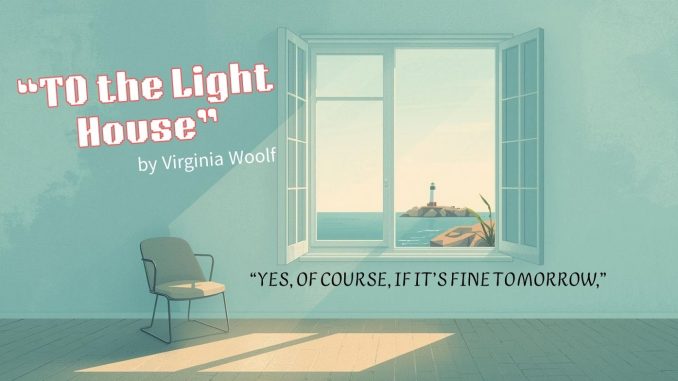
The opening of “To the Lighthouse” clearly shows these unique characteristics of Virginia Woolf. Mrs. Ramsay tells her son, James, “Yes, of course, if it’s fine tomorrow”.
We can see a mother trying her best to avoid hurting her son’s feelings. Sure, there’s a high chance he won’t be able to go, but what in the world is so certain and definitive? You never know until it happens. Except for the truth that everyone dies!
The mother wants to leave her child with enough joy. But at that very moment, Mr. Ramsay, the father, appears. With a blank expression, leaving no room for possibility, he strikes his target with precision like an ice pick. “But” he says, stopping in front of the drawing-room window (he even stops deliberately to say this). “It won’t be fine.” Yes. He was only stating a fact which he believes as true. But somewhere in the heart of the child who had hoped to go to the lighthouse tomorrow, a large hole left by his father’s ice pick remains.
This is quite famous novel so there are numerous Korean translations and most of them translate this part of Mrs. Ramsay’s reflections on her husband’s actions as follows:
““그가 말한 것은 옳았다. 그의 말은 항상 옳았다. 그는 거짓을 모르는 사람이었다. (What he said was right. He was always right. He never knew the lie.)”
The first time I read it, I unconsciously skipped over this sentence. But then something strangely gripped my attention. As I pondered it a second time, a part of me felt a slight discomfort. Strange. Why does the word “right” feel so uncomfortable?
Feeling something strange, I looked up the original text, and here’s how Woolf put it:
“What he said was true. It was always true. He was incapable of untruth”
There’s no praise or criticism here. There’s only a neutral description of the characteristics and nature of Mr. Ramsey’s language: that “what he said was true”. Nothing is about right or wrong.
At this point, a question arises:
Are telling that something is true and right really the same thing?
When language becomes a moral litmus test
The English word “true” is a relatively neutral word. In logic and mathematics, “true” or “false” is used to express the truth or falsity of a proposition. True is a statement that is necessarily true under given conditions or circumstances. That’s it. It simply asks whether the world is like.
However, the Korean word “옳다/oʊltɑː/(be right)” is a bit emotional. It involves the speaker’s judgment: a look of approval, a nod of approval. The word “옳다” simultaneously states the right/wrong and leaves the impression that the speaker is assessing the other person.
Thus, the character of Mr. Ramsey in the translation appears slightly different from the original. He moves from someone who simply states the facts, lacking empathy, to someone who always takes the right side, seemingly striving for moral perfection.
But did Woolf really want to portray him that way?
Korean Has Two Sets of Words for Judgment
Korean, kindly enough, provides two sets of judgment tools.
One is “be right” and “be wrong.”
When these words appear, the mood shifts slightly.
- l Was it okay to say that?
- l Was that choice appropriate?
- l What kind of person do we want to be?
These words are mostly used between people. Therefore, emotions easily surface, sometimes even leading to arguments.
The other is “true” and “false”
This is relatively quiet.
- l Is the result of calculation correct?
- l Is it consistent with the facts?
- l Is it within the norm?
There’s little moral tension here. Just check, correct, and move on.
The problem is that we often mix these two sets of words, and in the wrong way….
Thoughts become words, words become attitudes.
The moment the words we choose thoughtlessly come out of our mouths, people begin to judge us through those words. In other words, our speech patterns become perceived as our attitudes.
In other words, Mr. Ramsay’s statement that the weather will not be fine tomorrow is true. Yes, It’s true. But is his attitude OK? What emotional impact will his words have on those around him? Woolf withholds direct judgement but meticulously describes the emotional turmoil that unfolds within those around him as they listen to Mr. Ramsay. Perhaps this is how the reader empathizes with the other person’s emotional state, allowing them to consider how they should speak and what attitude they should adopt.
Which side were you on?
Finally, a very trivial question.
If there’s some words you think “This is true” in your mind, then let’s try to double check it. If that statement is truly true, from its motive to its conclusion? Was it a language that conveyed genuine meaning and that the listeners could comfortably agree with? If we can sense the small gap that exists in this question, perhaps we can become people who are a little more considerate of our surroundings.
As Virginia Woolf would show, rather than closing the door on relationships with inconsiderate words (even if they are true), we leave room for the other person’s feelings and thoughts.