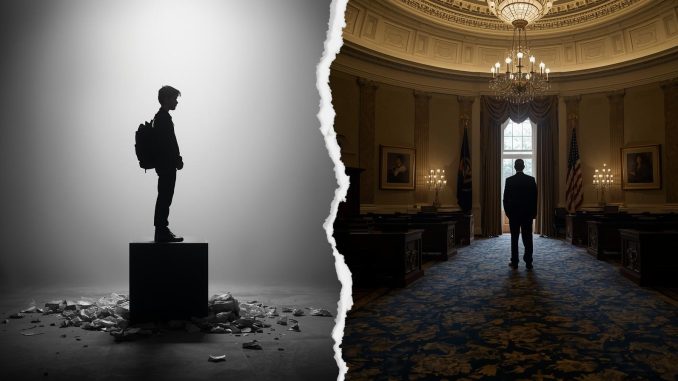
Lack of Empathy and the Responsibility of Education
Since the beginning of the new year, President Trump has been emphasizing “power diplomacy” through the arrest of Venezuelan President Nicolas Maduro, the annexation of Greenland, and the suggestion of intervention in Iran. Domestically, he continues a harsh immigration crackdown, attempting to make it a topic of discussion in the midterm elections scheduled for October. At the center of all this controversy is Stephen Miller.
The American media calls him the “planner,” “architect,” and “brain” of the Trump administration. Even referred to as the “prime minister”. This 40-year-old white man takes the most powerful roll behind the scenes, overseeing Trump’s domestic and foreign policies. The Atlantic described him this way: ” Stephen Miller runs his daily 10 a.m. conference calls—yes, even on Saturdays—less like a government adviser and more like a wartime general. His is the dominant voice, as he plays the role of browbeater, inquisitor, and bully. He accepts no excuses, entertains no dissent. “
Miller’s Worldview as a teenager
Growing up in Santa Monica, California, a stronghold of progressive thought, Miller was an eccentric with hard-right political leanings. On YouTube, still some videos offering a glimpse into his youth, when he embodied a “survival of the fittest” worldview and provoked progressive camp.
In a 2003 video with high school friends, he jokes about Saddam Hussein and his associates in Iraq, saying, “The ideal solution would be to cut off their fingers. You don’t have to kill them outright.” He adds, “Torture is a tribute to life and human dignity.” In another video, he runs for student council election and says, “Am I the only one tired of being told to pick up my own trash? We have plenty of janitors.” He also wrote an article criticizing the language skills of Hispanic students.
What do we feel when we watch these videos? Discomfort? Anger? Or a strange sense of connection, like, “I’ve thought that too.”
Somewhere between honesty and hypocrisy
“Are you tired of being told you have to pick up your own trash?”
Until you become a fully formed human with a high level of self-reflection, you won’t be happy to be told to pick up trash. The problem lies in how you handle this feeling.
Some people are too honest about this feeling that they even try to convince others to agree with them to justify their actions. Conversely, others don’t want to pick up trash, but they speak as if they deeply understand it, believing that only by saying so will society perceive them as more moral, self-reflective, and sophisticated.
What do you think of these two situations? Are both correct? Or are both logically true but not correct? Or is the first correct and the second incorrect, or vice versa?
Let’s dive into a more fundamental question: Why are we taught to pick up trash? Is it sufficient to simply say, “Because it’s the right thing to do,” or is it more persuasive to say, “Because I understand and empathize with the janitor’s hard work”?
The Absence of Narrative Imagination
Philosopher Martha Nussbaum proposes “narrative imagination” as a core competency for democratic citizens. This is the ability to intelligently read another’s story, to enter their inner lives and experiences, and to see the world from their perspective. According to Nussbaum, this imagination develops through reading literature and experiencing the lives of diverse characters indirectly. By living the lives of fictional characters, we learn to understand and empathize with those in situations different from our own.
So, what did Miller lack? The ability to imagine and empathize with the experiences of others—the hardships of a janitor’s labor, the difficulties of immigrants learning a new language.
About 2,500 years ago, Confucius said in the Analects:
人不知而不慍, 不亦君乎? (Rén bù zhī ér bù yùn, bú yì jūn zǐ hū?)
Not being angry when others do not recognize you, isn’t that what a gentleman is?
Here, a gentleman refers to a morally perfected person. In other words, a person of high moral character who acts as an example to others. However, considering this maxim, it seems that there are no proper politicians these days. Aren’t they all clamoring for the world to see them, and only them?
What about Miller’s attitude during his 10 o’clock conference call: “I won’t accept excuses or tolerate dissenting opinions.” Is this strong leadership, or is it a lack of empathy?
Can empathy be learned?
Schopenhauer once argued that empathy should be learned. Nussbaum goes a step further, arguing that literature and art can serve as tools for this learning. By reading novels, experiencing the lives of diverse characters, and accumulating experiences that allow us to see the world through their eyes, we gradually develop the ability to intelligently interpret others’ stories.
The ability to empathize with and listen to others’ opinions is precisely the virtue required of a politician. If so, isn’t the current education system completely flawed?
We are focused on competition during debate—on whose opinion is superior. In this debate culture, empathy becomes a wasteful luxury. When victory is the goal, understanding the other person’s suffering becomes a weakness. Wasn’t this the attitude Miller displayed throughout his school years?
So, let’s change the question. What kind of education should foster narrative imagination? Is it enough to simply shout the slogan, “Be considerate of others”? Or is it necessary to experience firsthand the work of a janitor or the language acquisition process of an immigrant?
Furthermore, as Nussbaum suggests, is it necessary to indirectly experience the lives of people from various classes and backgrounds through diverse literary works? Not simply as knowledge, but as an experience of seeing the world through their eyes and feeling their emotions.
A World Filled with Enemies
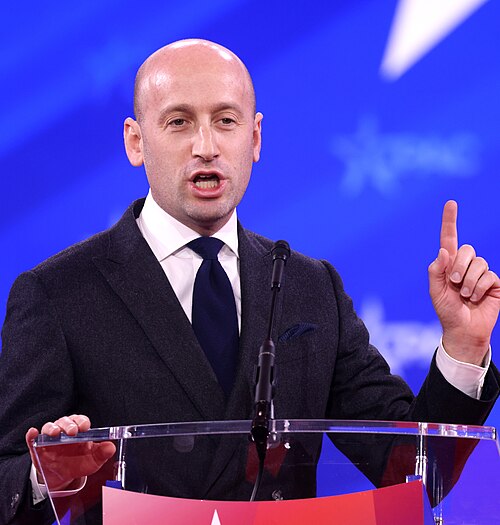
If we are to live as human beings in society (whether at work, in our community, or in our nation), it’s difficult to believe that only we are right and everyone else is wrong. Imagine how difficult it would be to live in a world where everyone else is wrong.
Stephen Miller will likely see all of humanity, save for a few like-minded individuals, as nothing more than enemies or something to be destroyed. If so, he will have to spend most of his life cleaning up this “garbage” (from his perspective)—the very garbage he so often protested on YouTube as a child, asking, “Why should I clean up when someone else is there to do it?”
Ironically, he’s now stuck doing the very thing he hated most.
The left questions
Is it the individual, the education system, or society that created someone like Miller?
If Miller had been in a different environment as a youth—for example, if he had the opportunity to interact deeply with people from diverse backgrounds and experience their lives firsthand—would he have become the person he is today?
And an even more uncomfortable question: How many of us recognize ourselves in Miller’s youthful remarks? So, what’s the difference between us and him? Was it simply that he spoke his mind publicly, while we kept it to ourselves?
Is empathy innate, or learned? If we can learn, are we teaching it properly now?
Polyview-Online welcomes your thoughts. Please send us your opinion via submissions@polyview.online