
With youth unemployment worsening, are we asking the right questions?
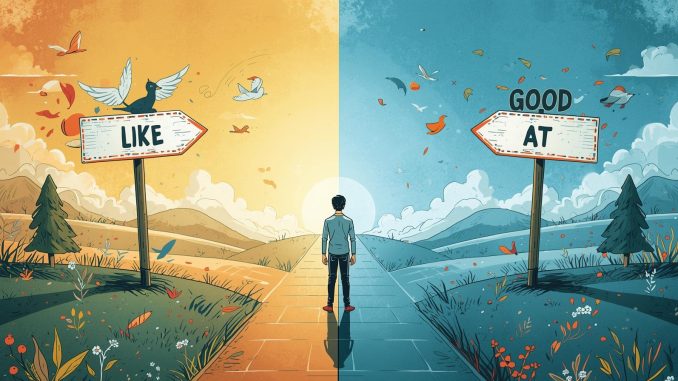
Under the frozen job market, many in their 20s and 30s are indiscriminately applying for recruitment, hoping to “just get a job somewhere.” Even in these circumstances, we still ask ourselves a cliché question: “Should I do what I love, or what I’m good at?”
But does this question truly address the core of career choice?
Is loving bread and working in a bakery synonymous?
Suppose a student has loved cake and bread since childhood and has spent time visiting famous bakeries. Naturally, this student decides to “make my love of bread my career” to become a pastry chef.
But at this point, we need to stop for a moment and think carefully. We need to consider the differences between loving bread and aspiring to be a pastry chef, just as loving soccer and becoming a professional soccer player are completely different. The passion in the stands and the sweat on the training field stem from the same “love of football,” but isn’t the request for professional football players, that is, professional football players, completely different from the love of football?
Realistically, if a student who loves baking wants to become a pastry chef, they would need to learn baking techniques for a certain period and then gain experience as an apprentice at a bakery or pastry shop. So, is what this student truly needs a love of bread, or are they the qualities required to work in a bakery?
Early morning commutes, repetitive tasks, physical exertion, and forming relationships with senior colleagues—how much do these factors relate to a “love of bread”? If turning a passion into a career can no longer be separated from a love of it, how should we prepare students?
What defines “good at”?
Consider a Korean student with excellent English grades. Adults around them, such as parents and teachers, often advise, “You’re good at English, so why don’t you become an interpreter?”
But what’s the similarity between getting a good grade in English and being able to work as an interpreter? Becoming an interpreter requires not only professional training and practical experience, but also the stamina and motivation to consistently study for a long period of time. Simply having a high language test score is not sufficient to become a simultaneous interpreter.
Let’s ask a more fundamental question: What do we base our judgments on when we consider a student’s “good” at something? Typically, we base it on school grades or proficiency in a specific skill. But how broadly do these assessments consider the context?
Let’s say a student is good at math. They score high on tests and are quick problem solvers. But can they also succeed as a mathematician or data analyst? Mathematicians require the patience to delve into unknown problems for years without definitive answers. Data analysts require understanding the business context beyond the numbers and the communication skills to persuasively convey complex analytical results to non-experts. Do the assessments of “good at math” measured in schools encompass these factors?
Therefore, “good” isn’t a fixed ability; it only has meaning within specific contexts and requirements. So, before we tell a student, “You’re good at this, so consider this career,” how well do we understand the spectrum of skills that careers require?
Can someone who’s good at drawing be an artist?
Let’s look at a more specific example. Imagine a student who’s both exceptionally good at drawing and enjoys drawing. At first glance, this student seems like the ideal case of both “liking” and “being good at.”
So, what does it take for this student to pursue art as a career? The idea of pursuing art as a career can conjure up countless careers, including becoming a full-time artist, an art critic, a museum curator, an art reporter, working at an auction house, or restoring ancient art. In this article, we’ll explore some of these paths to becoming a full-time artist.
To become a full-time artist, you’ll need to open your own studio and engage in creative endeavors. However, to achieve this (if your parents aren’t financially well-off), you’ll need to be selected for a commercial gallery or residency program, engage in initial artistic endeavors, and then sell your work. The first step toward becoming a full-time artist, finding a kind of sponsor, requires not just artistic ability, but a written proposal, like a business plan. You need to persuasively present your abilities and future vision in writing.
After selection? Ongoing communication with gallery staff and art journalists, as well as self-promotion through social media, are essential. One full-time artist laments, “How wonderful it would be if I could only pursue the work I enjoy and excel at.” However, that’s not the reality.
So shouldn’t the question we ask students not, “Do you enjoy and excel at drawing?” but “Are you prepared to handle proposal writing, networking, and social media promotion?”
What Dichotomous Questions Miss
I’m not arguing against considering what you like and what you excel at. I’m simply questioning whether the simplistic dichotomy of asking students to choose between what they like and what they excel at is problematic. How well do such questions truly reflect the complex realities students face?
It’s like starting a hike without a map and simply asking, “Which path do you want to take, left or right?” Isn’t the important thing not the direction of the path, but the terrain, how steep it is, what obstacles lie along the way, and whether I am physically prepared and have equipment to overcome them? To reach your destination, you must first understand the terrain by walking it yourself.
Students with a “good” focus on a specific subject or skill are unlikely to find employment in society based solely on that. Connecting “what you love” to a career can be even more challenging.
Does this mean that interests and strengths are completely useless? No. The problem lies in this simplistic categorization itself.
We need deeper and more diverse set of questions.
What are the necessary conditions for turning a passion into a career? We need to understand the object of our passion in more detail.
For a student who loves bread, why not try working part-time at a nearby bakery or cafe before applying to a prestigious baking school? Wouldn’t it be possible to experience the real effort required to earn money from a hobby you enjoy?
If you love art, why not try to be an apprentice in a professional artist’s studio, or work as an intern or unpaid supporter at a museum? Understanding the internal process of work should come first.
The same goes for “being good at something.” We need to redefine what we consider to be good at. What are the specific elements that make up what we’re good at? Through actual experience, wouldn’t we be able to concretely understand the level and specific aspects of what we’re good at?
Learning through experience, not just imagining things.
Important thing is that these concerns shouldn’t be confined to the mind. They should experience practical work like those elements and experience them firsthand.
In this era of job shortages, students are writing more resumes, but how much are they actually experiencing the realities of the careers they’re pursuing?
Before asking students to choose between “what they like” and “what they’re good at,” shouldn’t we first ask:
“Have you experienced what that job actually requires?” “Do you know the difference between something you like and making a living at it?”
“Have you ever seen how you think you’re good at actually working in the field?”
Career choices shouldn’t be a simple, hasty decision, but rather an exploration through diverse perspectives. And shouldn’t that exploration begin in the field, not in minds?