
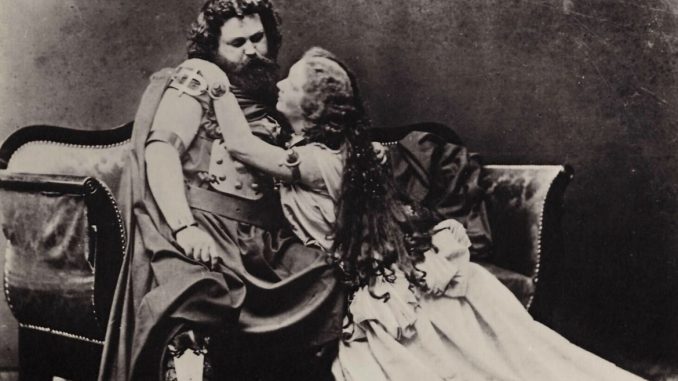
Korea’s growing enthusiasm for Western classical music has finally succeeded in summoning Wagner’s opera “Tristan und Isolde” to Seoul. This monumental opera was performed at the Seoul Arts Center for four days, from December 4th to 7th, 2025. Even the shortest performance lasts 219 minutes, and the slowest stretches to a staggering 265 minutes. What is it about this magnificent musical drama that captivates us so powerfully? Introductions and reviews of the opera are already plentiful, so we at Polyview would like to pose questions to our readers about this work. Please ponder these endlessly rising questions, like an infinite melody. If you have found answers to each question, or if you have additional questions that haven’t been addressed, please send your comments to submissions@polyview.online. Selected submissions will be published in the Opinion section.
Ⅰ. The “Tristan Chord” and Musical Historical Questions
■ Why did a single chord change the century?
- Why is the F–B–D#–G#, the so-called Tristan chord, that appears at the beginning of this opera’s prelude so significant?
- Similar chords existed before Wagner. So why did they create such a huge impact in this work?
- Wagner himself stated that he got the idea for a new harmonic progression from the introduction to the first movement of Beethoven’s Symphony No. 3. So what experimental harmonic progression did Beethoven’s Symphony No. 3 present to Wagner?
■ How were the hierarchies of keys and tones broken down?
- The hierarchy of the tonic and dominant notes in each key signifies the order of music. So, did the beginning of atonality, triggered by Wagner’s infinite melody, aim to dismantle this order and make all tones equal?
- What did Schoenberg, who ushered in the era of atonal music, intend to differentiate from the music of the previous generation through his “twelve-tone technique”?
■ Tristan and Der Ring des Nibelungen: The Question of Date of Creation
- At the time of composing Tristan, Wagner had not yet completed the entire four-part Ring cycle. So, do the latter half of Siegfried and Der Twilight of the Gods show notable differences in musical form from the first two works in the Ring cycle?
Ⅱ. Connections with Literature and Philosophy: Strata of Thought Surrounding the Works
■ T.S. Eliot’s Sense of Loss
- Why did T.S. Eliot borrow the phrase “The Young Mariner’s Lie” from Act 1 for his poem “The Waste Land”?
- Does the yearning expressed by the young Irish sailor reflect a longing (a sense of loss, nostalgia) for the homeland he was forced to leave behind?
- The similarity between the music depicting Tristan’s emotions in the first half of Act 3 and the Young Sailor’s Song in Act 1 suggests and amplifies the crisis (sense of loss) that permeates the entire opera.
■ Lars von Trier’s Anxiety
- Why did Lars von Trier repeatedly insert the theme from the opera’s opening prelude in his masterpiece, the film Melancholia?
- Did he believe this music, which intentionally excludes the “tension → relaxation” structure inherent in traditional Western musical harmony, symbolized the origin of the anxiety he sought to portray in the film: the uncertainty of the future?
■ Angelica Riedel’s Monologue and Interpretational Variations
- Why did Spanish director Angelica Riedel borrow the title of her monologue from Isolde’s aria (Love’s Death) in the final Act 3, which sings of the opera’s signature “consummation of love transcending death,” yet use the prelude from Act 3 (which reveals a sense of loss) as the background music instead of that aria?
- Did she reject Wagner’s assertion that “death is the completion of love,” concluding that death actually brings about eternal loss?
■ Nietzsche and Schopenhauer: An Ideological Crack
- Why did Nietzsche view Tristan as a complete work of art, simultaneously Apollonian and Dionysian?
- And why did he later criticize the work as provocative and irreverent, unlike his earlier work?
- Inspired by Schopenhauer’s thought, Wagner declared, “Life and death, all meaning and existence of the external world, depend solely on the inner movement of the soul.” Did this shift in thinking influence the opera?
III. Eroticism, Joy, and Death: Layers of Passion and Emotion
■ The Most Erotic Music?
- This opera is often called “the most erotic work in the history of music.” What is your opinion? Do you sense eroticism in this work?
- Do you experience a brief but intense joy, almost orgasmic, at the climax of the Act II duet?
■ What is the emotion of “Love’s Death”?
- What emotion do you feel in Isolde’s aria, “Love’s Death,” at the end of Act III?
- Is it an ecstasy, like entering nirvana? Or is it a “sensory illusion” we’ve been swept up in Wagner’s musical incitement?
- Is this aria a sorrow reaching into the depths of emotion? Or does it embody the supreme joy of believing in reincarnation?
■ What is the meaning of death?
- What philosophical function does death serve in this work?
- Does Wagner’s assertion that the cessation of sensation, death, transforms the imperfection of love into a state of perfection align with Schopenhauerian thought?
- If the prerequisite for the two protagonists to reach the ultimate state of love is overcoming the impossibility and absurdity of reality, then perhaps ultimate love can only exist in Isolde’s imagination?
IV. Questions Regarding the Play’s Structure, Direction, and Casting
■ Why transformed a simple plot into a grand musical?
- Why did Wagner seek to expand such a simple narrative into a vast musical?
- Unlike The Ring, where the wills of various characters clash against a vast setting, Tristan faces spatial constraints and behavioral constraints that prevent the characters from freely choosing their own actions. What was Wagner’s intention in adding these conditions to the work?
■ Casting Vision and Wagner’s Intentions
- Why did conductor Carlos Kleiber choose Margaret Price, a soft-sounding actress who had never sung the role of Isolde, over a soprano with a strong voice?
- Why did conductor Daniel Barenboim cast mezzo-soprano Waltraud Meyer as Isolde?
- According to Barenboim, Wagner’s original intention was to cast Isolde as a mezzo-soprano. So, what were the characteristics of Isolde’s character that Wagner initially intended?
■ Questions of Language, Rhythm, and Pronunciation
- Why did Wagner have Brangäne sing a lyric with a continuous flute rhythm before the love duet between Tristan and Isolde in the opening of Act 2? (This same approach was also applied to Brünnhilde in Act 1 of The Twilight of the Gods.) Was this a calculated attempt by Wagner?
■ Contradictions in Character and Emotion
- Isolde displays a profoundly self-centered tendency throughout the work, so how does she sing of the perfect consummation of her lover’s corpse in the finale?
V. Issues of Musical Structure and Interpretation
■ Infinite Melody and Absurdity
- What connection does Wagner’s intention (effect) of creating the feeling of “unbroken flow”—infinite melody—created by unresolved chords have with the absurdity of life described by Camus in The Myth of Sisyphus?
- Was this an attempt to portray the absurdity of human life (existential problems) through musical drama?
■ What does the pastoral introduction to Act 3 foreshadow?
- What does it mean that Act 2 begins with intense physical love and then concludes with a radical severing of that emotion, and then Act 3 begins with a gently resonating pastoral and nostalgic melody?
- Considering the overall structure of Act 3, does the musical emotion of this introduction fully resolve itself by the final act, Isolde’s “Love’s Death,” or does it remain incomplete and elusive?
- If it is not fully resolved, how can we believe that we experience ultimate ecstasy? What choice does Wagner make regarding the traditional principle that the cadence should resolve the ambiguity of musical structure?
■ Interpretation of Death
- If it is not fully resolved, how can we believe that we experience ultimate ecstasy? What choices does Wagner make regarding the traditional principle that cadence should resolve the ambiguity of musical structure?
VI. Questions about Differences in Appreciation and Musical Taste
■ What does it mean to love Wagner?
- How does loving Wagner’s operas differ from loving Verdi or Mozart’s?
- If Isolde embodies climax, ecstasy, paradise, pleasure, and destiny, how does this differ from the characterizations given to the female protagonists in previous Wagnerian operas?
- In the final aria, “Love’s Death,” do we hear true love, or an obsession that rejects reality?
Conclusion: A Resonating, Recurring Curiosity
<Tristan und Isolde> is a work that endlessly poses questions. It endlessly layers music, philosophy, desire, death, unresolved harmony, and the deepest human emotions onto a simple plot. Thus, the more we question this opera, the more questions we find ourselves asking, like an infinite melody.
But perhaps appreciating Tristan und Isolde isn’t about “solving” these questions. Rather, isn’t the essence and power of this work to wander and ponder within these questions, experiencing the imperfections of our own lives?
In other words, perhaps the infinity that prompts us to endless questions the moment we encounter the work—to confront our inner emotions—is the true greatness of Wagner’s music, and of Tristan und Isolde.
